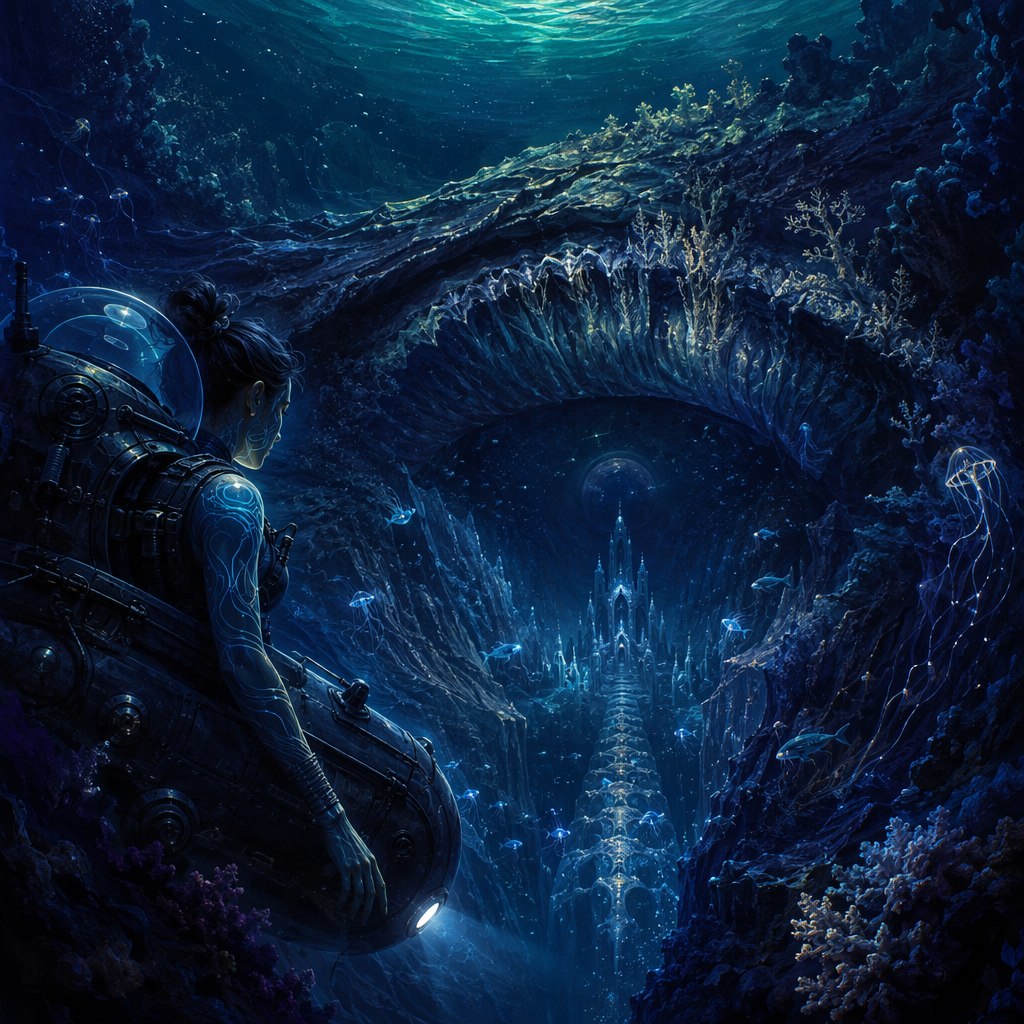
Bathymetry of the Vanishing Bride
A cartographer dives to chart an impossible trench that migrates between heartbeats. In the crushing dark, every contour answers with her childhood, her hungers, and a map inked inside her bones.
The Blank on the Admiralty Sheet
Chapter 1: The Blank on the Admiralty Sheet
The summons arrived folded into oilskin, as if it had crossed water to reach her, though the courier’s boots were powdered with city dust.
Elian Vale was in the hydrographic archive beneath the university, where the air smelled of mildew, lampblack, and old salt trapped in paper. Around her, the world’s coasts slept in drawers: estuaries like green veins, shoals stippled in patient numerals, reefs indicated by tiny symbols delicate as surgical scars. She had spent twelve years teaching the sea to confess itself in contour lines. There were trenches she knew better than certain lovers. Banks she trusted. Canyons she had named from soundings and mathematical grace. Yet all morning she had been trying, and failing, to correct a flaw in a nineteenth-century survey of the Crozet Plateau because the hand that made it had trembled at the wrong moment, and now every line seemed less an error than a pulse.
When she slit the oilskin with her thumbnail, a smell came out—cold iron, iodine, something singed.
Inside was a single card the color of a pearl’s inner bruise.
ELIAN VALE,
Your reputation for impossible measurements recommends you. Present yourself tonight at nine bells, Pier Nine, dry dock annex. Burn this invitation. Bring no assistant.
No signature. In the lower right corner an embossment had been pressed so hard the fibers had nearly broken: a circle scored by seven descending lines.
Elian held the card under the green lamp until the letters gleamed. Impossible measurements. She almost laughed. That was what they called her now, in rooms where grants were distributed by men with soft hands and expensive watch chains. Not the woman who had charted three submarine landslides before they happened. Not the one who could reconstruct a drowned ridge from echoes as a blind pianist reconstructs a cathedral from acoustics. Impossible measurements, as if impossibility were a species one might trap, pin, and classify.
She fed the card to the archive stove and watched the fire take it in one blue lick. The embossed symbol blackened last.
Outside, the city was all wet slate and gull-throat dusk. Rain had passed and left the cobbles shining like fish skin. At the harbor, cranes stood against the sky with the prayerful menace of wading birds. Pier Nine lay beyond the customs sheds where the light changed character, becoming industrial and underwater somehow, every bulb haloed in mist.
The dry dock annex was a concrete cube with no markings except old rust stains that looked from a distance like continents. A guard in a navy coat opened the steel door before she knocked, as if he had been listening through the metal for the shape of her hesitation.
Inside: warmth, polished wood, and a table so long it seemed designed for surrender. Five people sat along one side of it, each with the expression of someone who had been taught at great expense not to show expression. Behind them, tall windows looked onto the black basin of the dock where an unlit vessel waited, low and sleek as an unanswered question.
No one invited her to sit. So she sat.
“You’re punctual,” said the woman at the center.
She was silver-haired, narrow-faced, and wore no jewelry except a wedding band made of some dark metal that drank the light. On the table before her rested a folder embossed with the same symbol from the invitation.
“You know my name,” Elian said. “I’d prefer the courtesy returned.”
A pause, expertly measured.
“Lys Maren,” said the woman. “Speaking for the Pelagic Consortium.”
The term was broad enough to conceal either governments or thieves. Probably both.
“To what end?”
Maren opened the folder and slid out an Admiralty sheet under glassine. Elian knew at once that it was recent; the paper still had that faint chalky smell of precision ink not yet fully cured. Latitude and longitude, current arrows, soundings, navigational warnings: all the apparatus by which uncertainty is disciplined. She bent over it.
At first she thought the sheet unfinished. Then she understood.
There was a blank in it.
Not a simple omission, not white paper left where data had not yet been entered. This blank had edges. It occupied the chart with intent, an absence so clean it seemed incised. Around it, bathymetric contours crowded and then recoiled, as grass around the mouth of a sinkhole. The empty shape was long, narrow, and slightly curved, like the imprint left in a bed after someone rises before dawn.
Elian looked up.
“There are no blanks on Admiralty sheets.”
“Quite,” said Maren.
“Who altered it?”
“No one.”
Elian laughed then, because the alternative was to let a primitive unease open its cold petals under her ribs. “You’ve called me here for a forgery?”
A man two seats down, rawboned and pink around the eyes with lack of sleep, slid a dossier toward her. Satellite stills. Sonar strips. Telemetry logs. Each was marred in a different way. Optical passes dissolved into static over a fixed set of coordinates in the South Atlantic. Infrared showed a feverish smudge and then nothing. Synthetic aperture radar returned a texture like old wool. Side-scan sonar from three separate research vessels depicted, on three different dates, three incompatible submarine landforms in precisely the same location. A ridge. A basin. A throat.
“Elaborate spoofing,” Elian said, though more quietly.
“We thought so,” said the rawboned man. “The first six months.”
“How long has this been happening?”
“Twenty-two months.”
The number sat between them like something with teeth.
Maren folded her hands. “We maintain shipping, extraction, and communication interests in the region. Two cables already require rerouting. Insurance underwriters are restless. More importantly, vessels passing within eighty nautical miles have made reports.”
“What kind of reports?”
No one answered at first. Rain ticked on the high windows. Somewhere in the dock a chain shifted, and the vessel outside answered with a low, metallic complaint.
At last Maren said, “Auditory anomalies.”
Elian nearly smiled. “The sea is an auditory anomaly.”
“This is more specific.” Maren glanced at the others, as if permitting herself a distaste. “Sailors hear their names underwater.”
The room did not laugh with her because she did not laugh.
“What exactly do you mean, hear?”
“During watch. During sleep. While diving to inspect hulls. Sometimes from beneath the keel. Sometimes through the pipes. One bosun reported hearing his mother use his childhood diminutive from twenty meters down, in a sea state that should have made any such perception impossible. A trawler crew refused to cross the coordinates after half the men heard knocking from under the icebox and one heard his own voice asking to be let in.”
The rawboned man opened another file: typed statements, a few handwritten in block capitals as if to keep the hand from shaking. Elian skimmed.
…like someone speaking through a mouth full of water but I knew it was Tomlin, dead these eight years…
…the sound came up the anchor chain one link at a time…
…I thought at first there was a child in the ballast tank…
She placed the papers down carefully.
“Sailors are devout manufacturers of nonsense.”
“And hydrographers,” Maren said, “are manufacturers of certainty. We are employing one because the other has become expensive.”
Elian leaned back. She could feel the old, dangerous quickening in herself now—not belief, exactly, but appetite. The appetite for an edge where instruments fail and one must go personally, with skin and judgment, into the place where the world refuses simplification. It was this appetite that had cost her a marriage, a fellowship, and two vertebrae. It had also made her excellent.
“Why me?” she asked.
The silver-haired woman studied her with a gaze so unblinking it seemed borrowed from some pelagic fish.
“Because your father worked the Nereid surveys,” she said.
The quickening went still.
Elian’s palms cooled. “My father is dead.”
“Yes.”
“He charted the continental rise. Not the South Atlantic.”
A very slight shrug. “Records are often less complete than charts pretend.”
Her father’s name had not crossed a stranger’s lips in years. Gideon Vale: a man who smelled of coffee, engine grease, and storm wool; who could tie knots behind his back; who disappeared when she was thirteen between one sounding and the next, leaving only a watch stopped at 03:17 and a government letter so euphemistic it might have been composed by furniture. Lost at sea. As if the sea were a station and he had missed his stop.
She looked again at the blank on the chart. Something about its outline needled memory. Not a place she had seen, but a gesture. Her father lifting a sheet from a drafting table. Her own body under hospital cloth after the accident in the Kermadecs, when they had cut her suit away and she had looked down, half-drugged, at the livid seam crossing her abdomen like a coastline after war.
“What vessel?” she asked.
Maren allowed herself the smallest exhalation of victory. “The Bride. Retrofitted for deep submergence and multibeam survey. You would have operational authority below deck and in the water. A six-week window. Triple your usual fee.”
“I don’t have a usual fee for fairy tales.”
“Then set an unusual one.”
Elian rose and went to the window. The basin lay black as developed film. The vessel at berth was longer than she had imagined, painted a blue so dark it entered black by consent. On the bow, in discreet pale lettering: BRIDE.
Not The Bride. Just Bride, naked as a command.
A deckhand crossed under a worklight carrying a coil of cable over one shoulder. The coil shone wetly, and for one vertiginous instant it looked to Elian like a strand of spinal cord lifted from some gigantic body. The image struck her with such force she tasted copper.
In the water beside the hull, something pale moved.
Not a fish. Not a reflection.
A face, she thought absurdly, turned upward from under the skin of the dock basin as if pressed there from below. It vanished when she leaned closer. Only rain-rings. Only black.
“You’ve already prepared the vessel,” she said without turning. “So you were confident I’d accept.”
“We were confident,” Maren said, “that if you refused, you would regret it more than if you didn’t.”
Elian put her hand on the cold windowpane. The glass hummed faintly beneath her palm, or perhaps that was the dock itself carrying some submerged machinery’s vibration. Yet in that hum there seemed, impossibly, a pattern—three beats, a pause, then two. The body trying to become language.
Then she heard it.
Not from the room. Not from any human mouth.
From below the waterline, soft as breath against a sleeping ear, came her name.
“Elian.”
She did not move. Behind her, no chair scraped, no one gasped. Perhaps no one else had heard. Or perhaps they had all been waiting for the moment the trench, whatever it was, reached through steel and rain and masonry to lay one wet finger on the page of her life.
Again, a little clearer. Patient. Intimate.
“Elian Vale.”
When she turned from the window, every face at the table was watching her as if she had just answered a question aloud.
Soundings That Refuse to Stay Sounded
By dawn the harbor had become an apparatus of departures.
The Bride of Quiet waited beyond the fuel pier with her white hull gone pearl-gray under a low weather ceiling, as if the morning had not yet decided whether to permit color. She was longer than Elian had imagined from the files: not graceful, exactly, but composed, all her function gathered into a kind of severe poise. Winches crouched along the aft deck. Cranes folded their elbows against the sky. Radomes sat on the superstructure like smooth, blind skulls. There was a laboratory banked with lit screens where already numbers streamed in marine-green columns, and under the deck plates the engines worked with a patient, caged vibration that rose through the soles of her boots into her knees.
Research vessels always smelled to her of three things in unequal marriage: cold metal, stale coffee, and brine old enough to be almost sweet. This one carried a fourth note underneath—ozone, perhaps, or singed dust from electronics run too hard. A smell like a storm trapped in wiring.
She stood at the starboard rail as tugs shouldered them clear of harbor. The city withdrew with the insulted dignity of something left awake too early. Warehouses flattened into blocks, cranes into strokes of charcoal, church spires into pins. Gulls rode the wake and screamed as if translating the engines into a simpler grammar.
“Sea state building by evening,” said First Officer Nox, appearing beside her with no preamble. He was one of those men who looked assembled from weatherproof materials: compact, dark-faced, with eyebrows like severe accents. “If you want your ceremonial first cast in decent conditions, I’d make it before noon.”
“Ceremonial?”
“Scientists are worse than priests. They just insist they’re not.”
Elian glanced at him. “Do you believe in the trench?”
“I believe in payroll, fuel consumption, and what my sonar tech threw up over the rail three nights ago after hearing his dead brother ask for a cigarette through six thousand meters of water.”
Nox looked steadily ahead as he said it, giving the sentence no hospitality. Then he touched two fingers to the brim of his cap and went below, leaving her with the wake unraveling behind the ship like a seam opened by an invisible knife.
By 1100 they were over the coordinates the Consortium had delivered in a locked packet and then contradicted twice by encrypted update. Latitude and longitude sat on the screen like any other pair of numbers, modest and exact. The sea above them was almost offensively ordinary: a gray-blue plain under bruised cloud, small wind-ruffles traveling over it like thought passing under skin.
The bridge darkened for instrument work. Monitors painted the faces around her in submarine colors. Operators spoke softly, with the liturgical economy of people who know that too many words fog precision. Elian took the central station, slid on the headset, and called for the first multibeam sweep.
A transducer pulse went out beneath them—a brief, inaudible violence, all mathematics and pressure. On the display the seafloor assembled itself line by line in false color: shelf, slope, deeper declivity. She watched the trench emerge not as a revelation but as a betrayal.
There it was.
A cut in the continental skin so abrupt it looked less eroded than opened. Its flanks descended in severe planes that broke unexpectedly into terraces and overhangs impossible at that depth and sediment regime. The floor vanished below the system’s initial range gate.
“Depth?” she said.
“Eleven thousand two hundred and—” The technician stopped. “No. Wait.”
The number stuttered, revised itself downward by nearly eight hundred meters, then climbed again. The image wavered. Not static—never static. It had the queasy, muscular instability of something holding a posture only while observed.
“Compensate for roll. Recheck timing bias.”
“Already did.”
“Velocity profile?”
“Nominal. Unless the laws of acoustics changed while we were making coffee.”
A few strained laughs. Elian leaned closer. The trench walls on the screen appeared faceted, then ribbed, then smooth again. One contour line detached and drifted a fraction east before snapping back as if on memory.
“Run it again,” she said.
Second sweep. The pulse dove.
This time the trench was narrower, deeper, canted slightly to the south. A spur canyon that had not existed thirty seconds ago now extended like a finger toward the vessel. A mound on the western wall rose in a geometry so regular that for one embarrassing heartbeat Elian thought architecture, and then she corrected herself viciously: slump block, basalt outcrop, interpolation error, anything but intent.
“Overlay both passes.”
The screens complied. Two trenches occupied the same coordinates with the intimate disagreement of twins who have learned to counterfeit each other’s faces.
No one in the room moved. Even the usual ship noises seemed to recede, as if the hull itself were listening through its plates.
“Camera package ready,” came a voice from aft control.
“Deploy.”
Out on deck the air had sharpened. A rain not yet committed to rainfall moved in the wind as separate cold needles. Elian watched from under the gantry as the camera array swung on the A-frame, black housings wet as seal eyes, umbilical spooling after it. Floodlights sat caged behind acrylic domes. Pressure cases held the downward-looking cameras, side-scan units, environmental sensors, inertial package, backup lights, backup memory—human beings’ whole touching faith in redundancy.
“Lower away.”
The array descended. Cable paid out with a smooth, expensive whine. It struck the surface and for an instant became a broken lantern under the water, then sank.
They tracked it in the control room by depth readout and grainy real-time feed. Upper water column first: green collapse, marine snow crossing the lights like the ash of a drowned library. Then blue strangled to black. Particles thickened. The cable shivered faintly with currents too slow to notice above and tyrannical below.
At three thousand meters the first anomaly appeared.
Not on the seabed. In the dark itself.
The forward camera, which ought to have shown only suspended matter and its own light cone, recorded a pale vertical trace crossing the field. It was too close to be fauna and too deliberate to be noise. It looked, absurdly, like chalk drawn on the inside of night.
“Freeze that.”
The image held. The line trembled, then blossomed into branching filaments, then vanished altogether when the software sharpened the frame.
“Artifact,” said someone quickly.
“Of what?”
No one answered.
They continued downward. Sonar painted the trench opening beneath the package: a mouth, a wound, a signature. Elian refused all three nouns and concentrated on numbers. Depth. heading. cable tension. acoustic return strength. Yet each metric came back with the faint insolence of having been altered by the act of asking.
At 7,400 meters the side-scan registered a wall to port at twenty meters.
The camera showed nothing.
At 7,402 meters the camera revealed a sheer escarpment stippled with white organisms or mineral efflorescence.
The side-scan showed open water.
At 7,405 both systems agreed on a descending ledge. Relief moved through the room—brief, embarrassing, almost superstitious—until the ledge on-screen folded inward along a line too clean for geology, like fabric being pleated by giant invisible fingers. It held that impossible crease for two full seconds. Then, because all four cameras had turned toward it, it relaxed back into stone.
Elian felt the skin across her shoulders tighten.
“Did you see—”
“Yes,” she said, before anyone could say what.
They sent the second package: an autonomous profiler with independent optics, no tether, no shared clock. If one system was contaminated, the other would stand apart and witness cleanly. It dropped free and disappeared with bureaucratic obedience.
Its first packets arrived three minutes later. Different trench. Same coordinates.
This version opened as a spiral depression, broad and elegant, descending in a curve no tectonic process could have authored. The profiler’s lidar returned smooth walls scored at regular intervals. Not random marks. Graduations. Tick-marks, patient and vertical, as if some colossal instrument had been lowered here not to measure depth but to teach it manners.
Elian felt something old and feral stir in her chest. Not fear—not yet. Recognition’s counterfeit.
“Bring up Gideon Vale’s Nereid archive,” she said.
The room shifted around her. A few faces lifted. The technician at data did not argue, which was argument enough.
“Restricted,” he said.
“Override.”
He looked toward the glass partition where the Consortium liaison stood pretending not to eavesdrop. Her suit was too elegant for sea-work, her hair untouched by humidity, her expression arranged into an expensive neutrality. She gave the smallest nod.
The files opened.
The Nereid records were mostly ruined in exactly the ways digital things are ruined when someone has panicked around them—corrupt headers, amputated timestamps, sections overwritten with zeros like little fields of snow. But one image survived, low-resolution, monochrome, stamped seventeen years old.
A trench wall. Or something claiming to be one.
Along it, in faint pale intervals, a ladder of marks descended into blur.
The same spacing. The same impossible regularity.
Elian leaned so close her breath fogged the monitor. In the lower corner of the image, just inside the edge of frame, there was a shape she at first took for a gloved hand touching the camera housing from outside. Five pale suggestions, splayed.
Then the profiler transmission shrieked.
Not through the speaker system. Through every metal object in the room.
A thin, rising note came out of the consoles, the chair legs, the bolts in the deck, the wedding band on the technician’s finger. It was as if the ship had discovered a single unbearable vowel and could not stop pronouncing it. People clapped hands to their ears. One screen went white. Another filled with streaming bathymetric lines that bent, converged, and resolved with horrible calm into a human outline seen from above—as if someone were drawing Elian’s body by depth contour.
Head. Shoulders. Rib cage. The delicate inward shore of waist.
And at the center of the chest, where the sternum narrowed like a channel, the trench opened its black mouth and began to deepen.
The First Descent and the Choir of Anchors
By noon the sea had put away all theater.
It was a flat, worked metal under a whitening sky, a sheet hammered so smooth that distance had nowhere to gather. The Bride of Quiet rode it with an offended dignity, every cable taut as nerve. Men and women moved softly on deck without speaking above the pitch of the winches. Even the gulls had abandoned commentary. It was as if the ship had entered a chapel built from pressure and salt.
Elian stood in the submersible’s cradle while the crew completed the last checks around her, each touch on the hull sounding through the acrylic nose as a small, domestic knock, absurdly like someone asking entry to a room already occupied. The sphere before her was so clear it was almost not there; beyond it the day burned pale and depthless. Behind her shoulders the cabin narrowed into machinery: banks of lights, manipulator controls she hoped not to need, twin thrusters, the stitched arithmetic of oxygen, scrubbers, ballast. The air smelled of warm wiring, machine oil, and the iron-cold tang of her own apprehension.
Roux leaned in through the hatch before dogging it shut. His face was upside down for a moment, inverted in the curved glass, a moon with a beard.
“If it changes, you come up,” he said.
“It has already changed.”
“You know what I mean.”
She almost smiled. “No one ever says that sentence before good things happen.”
His hand rested once against the hull. Through the acrylic his palm became a pale marine creature, five-boned and translucent. “Don’t follow it if it invites you.”
“Invites me how?”
But he had no answer, or would not spend it. He sealed her in.
Then there were only procedures. The tiny liturgy of descent. Valves checked, comms checked, internal pressure checked. The crane took her weight. Metal groaned. The submersible rose from its cradle with the disorienting tenderness of a spoon lifting an egg. For an instant she hung above the deck and saw the ship from outside as no passenger ever did: all its rails and winches and rust seams, all its laboring lines. It looked less like a vessel than a thought that had learned to float.
Then the sea received her.
The first contact was a slap, a green bloom across the nose. Bubbles swarmed upward in frantic silver punctuation. Surface light shattered and reassembled around her. She dipped, steadied, and began to sink.
There is always a vulgar phase to descent, she thought. Noise, turbulence, color. The sea pretending to be weather. Then the blue thickened. The ship above became a wavering coin, then a pin, then a rumor. She could feel, through no sensible mechanism, the world adding itself on top of her in layers. Weight translated through water into intimacy. Pressure was not force but attention.
“Elian, read me.” Roux in her ear, grainy and near.
“Reading.” Her voice sounded clipped, all surface. “Dropping through forty meters. Visibility good. No particulate bloom. Heading one-eight by east toward anomaly coordinates.”
“Copy.”
The instruments behaved at first with almost offensive propriety. Depth climbed. Sonar painted its fan of confidence. The trench’s expected position on the forward display waited as a bracketed absence. She watched it approach through figures and gradients, though she knew by now that numbers here were only manners the abyss put on for company.
At one hundred and eighty meters, the water darkened from blue into a color without a terrestrial name. Not black. Not violet. A saturated nullity, the hue of a bruise on a god. Bioluminescent things began to appear, each in its own punctuation mark of life: commas, errant dashes, one animal trailing a paragraph of cold fire behind it. She passed through them slowly, and their light stroked the hull as if reading Braille.
At two hundred and twelve meters the forward sonar faltered.
Not failed. Faltered, as if embarrassed. The trench should have opened below and ahead in a clean drop. Instead the display showed a shelf, then a wall, then open water where rock had been a breath before. Her altimeter spun through impossible confidence. She switched frequencies. The side-scan returned a geometry that made her teeth ache: a curve tucked inside a sharper curve, both lined at exact intervals like the marks on a measuring staff.
The lip of the trench appeared only when she was upon it.
No grand escarpment announced itself. No cinematic crack in the seabed. The seafloor under her simply lost conviction. Sand and stone trailed off into a darkness so complete it seemed not an absence of light but the presence of another material, as if someone had cut a wound into the planet and the blood was matte. Around the rim stood outcrops that looked from one angle geological and from another worked, as if basalt had learned architecture by overhearing cathedrals.
“I have visual on the margin,” she said.
“Describe.”
She opened her mouth and closed it. The trench’s edge was changing too quickly for nouns. It folded while she looked at it. Its slope acquired terraces, erased them, offered a spiral, denied it. It had the indecency of a face rearranging itself between glances.
“It’s not stable enough to describe honestly.”
A pause. “That is an honest description.”
She trimmed the ballast and nudged the submersible over.
The sensation of crossing the lip was not descent but acquiescence. The sub gave a minute, involuntary tilt, as though some hand far larger than gravity had taken the nose between finger and thumb. The lights ahead entered the trench and returned a little less than they should have. Walls rose around her, then leaned away, then seemed to be below her while she remained somehow level. She had mapped canyons, escarpments, seamount flanks. She knew what relief did to the eye. This was different. This was topology behaving like memory.
Then something rang.
A single note, small and ferrous.
Elian jerked so hard her shoulder struck the console. The sound had come not through comms but through the water and hull both, a struck-metal sweetness warped by depth. It hung for a moment in the cabin, impossible and exact.
Another answered, lower. Then three together, then a staggered cluster, until the dark ahead filled with chiming.
She pushed the lights wider.
At first she mistook them for outcroppings. Then the beam caught an arm, a fluke, a stock furred with marine rust. Anchors. Dozens. Hundreds. No chain attached, no cable, no visible support. They hung in the water column at different depths and attitudes, each held in place as if embedded in invisible earth. Admiralty anchors with their formal old curves. Crude fisherman’s hooks of iron. One modern stockless pattern whose shank had been bent into a question. They occupied the trench like a congregation interrupted in the act of kneeling.
Current moved through them.
Not a current she could read on the instruments; those remained negligible. But something passed there, some process finer than flow, and each anchor answered according to its size, its rust, its private wound. The notes did not merely sound. They sought one another. They braided. The whole trench became a bell struck under miles of sleep.
Her scalp tightened. She knew this noise.
Not knew. Recognized.
In the music there was cadence. Between one chime and the next an arrangement of pause and emphasis, a household timing, the shape certain sentences had taken over the kitchen table when she was small and feverish and her mother sat peeling pears in one spiral rind, saying, Elian, not so fast, the world isn’t going anywhere, you must let it arrive. The exact habit of a breath before reproach. The tiny lift at the end of a word when amusement was being smuggled inside annoyance.
“No,” Elian said aloud, to the trench or herself.
“Say again?” Roux crackled.
She could not answer. The anchors were speaking in no language she would submit to transcription, yet every phrase landed in her with ruinous precision. Not the words themselves—the motion beneath words, the mother-metric by which meaning enters before logic can inspect it. Come here, the chimes suggested, with unbearable gentleness. You have made so many measurements. Let something take yours.
The nearest anchor hung just beyond the nose, a massive old thing from some ship no archive had kept. Its iron was layered with oxide in petals and ridges, red-brown as dried blood, but in the beam its corrosion glowed almost velvety, like the skin of a peach left too long in a drawer. Barnacles crusted one arm. Tiny blind shrimp worked in and out of it like thoughts too small to confess. Along the shank, scored at regular intervals, were incisions. Graduations. The same measured spacing she had seen in Vale’s image. The same impossible neatness.
She reached for the manipulator controls before realizing she had already unfastened one glove.
Her bare hand hovered over the acrylic. A child’s gesture, obscene in its futility. On the other side of the glass the anchor seemed to turn, not physically but in significance, presenting itself.
“Elian,” Roux said, louder now. “Your respiration is spiking. Report.”
The chimes shifted. Her mother’s cadence altered with them. No longer kitchen-gentle. Hospital-soft. The voice from the final winter, when each sentence had to climb out through pain and smile anyway for the daughter beside the bed. You mustn’t make your life out of looking for me, it said—or almost said; the anchors translated not meaning but ache. And beneath that, another rhythm, interleaved and colder, patient as a survey line: We have already begun.
Her displays flickered.
The trench walls brightened on the sonar not as stone but as contour lines laid against a body. Shoulder. Spine. Pelvis. A human form impossible in scale, nested in the abyss like an embryo inside obsidian. Data crawled over it. Every return point sought correspondence. Every depth wanted anatomy. Her own pulse jumped in the wrist sensor, and the central screen accepted it greedily, converting heartbeat to range.
On the glass ahead, where only her reflection should have floated faintly over the dark, another image took shape from condensation that should not have existed in the stable cabin climate: the outline of a woman seen from behind, hair pinned at the nape the way her mother used to wear it while working over charts at the dining table, though her mother had never gone to sea except in stories.
The figure lifted one hand and pointed deeper into the choir of anchors.
Then all the suspended iron rang at once, and something enormous moved below her lights.
Isohypses of the Flesh
The first prediction was small enough to dismiss as fatigue.
Elian lifted her left hand toward the ballast release out of habit, not intention—a hover only, fingers opening in the practiced crescent that meant wait, assess, do not commit—and on the forward display a pale filament of light ran ahead of her through the trench wall, sketching the movement half a second before she made it. A ghost-hand. Not a reflection: the angle was wrong, the timing worse. The line appeared inside the basalt, a white articulation traveling through stone as if the rock contained nerves.
She froze. The filament froze too, one impossible beat in front of her.
The submersible hummed around her like a tooth under pressure. Outside, the anchors continued their slow pendular choir, each iron body turning in the black on its own private axis, each strike delayed by water into something less like sound than the memory of sound. The cabin smelled of copper, warm circuitry, and the faint medicinal rot of recycled air. Her own breath had become a system she no longer trusted.
“Telemetry lag,” she said aloud, because language was another instrument and instruments could steady a hand.
The trench answered by brightening.
Not all at once. Rather, lines came alive in the dark wall opposite the viewport, one after another, a patient kindling, as though some giant thing behind the rock were tracing with a cold finger all the routes she might take next. Here the hand to ballast. Here the thumb to thruster trim. Here the involuntary flinch toward the cabin light controls. A diagram of her hesitation flowered around her. The lines were contour-thin and mercilessly exact. They bent, braided, reappeared where no Euclidean courtesy should have allowed them. Looking at them gave her the prickling conviction that her skeleton had been understood by weather.
“No,” she whispered.
And because denial is an invitation in certain places, the controls woke under her palms.
The starboard thruster indicator pulsed before she touched it. The manipulator arm icon on the side panel opened and closed, opened and closed, in the rhythm her own right hand was still considering. On the depth plotter, tomorrow’s decisions were arriving an instant before the present. She had the hideous sensation of being overtaken by herself—not by memory, but by anticipation, as if the trench had found the shape of her will and was laying track in front of it.
Elian pulled her hands into her lap.
On the monitor her hands remained, rendered in sonar approximation as two phosphor blooms suspended over the console. Then those too folded away, a fraction before her muscles obeyed.
A blister of laughter rose in her throat and died there. It was the laughter of bad edges—the kind people produce on catwalks, in operating theaters, on icy roads just before impact.
Her wrist itched.
She ignored it. The itch deepened into a sting. Then came another at the inside of her elbow, another at the base of her neck beneath the collar seal, another low on the ribs where the harness crossed her. Pressure artifacts, she thought. Stress hives. Some contamination in the suit lining. She shoved one hand under the cuff and scratched, and the pain was so acute she gasped.
When she yanked her sleeve back, her skin looked as if it had been engraved by a patient cartographer.
No blood. No welts exactly. The marks were raised and pale at first, then pinkening as she stared: a nest of minute, concentric ridges traveling from the heel of her palm toward the pulse point. They were too regular for irritation, too intricate for accident. Isohypses. Contour lines. Not decorative, not random. They held intervals. They enclosed elevations she could not name.
For one absurd second she thought of those old novelty globes that rose under a child’s fingertip, mountain ranges in blue plastic. Then the pattern shifted.
Not on the skin itself—God help her, not that—but in her understanding of it. Her eye found relation. A shelf. A basin. A sharp escarpment dropping to a plain scored by channels so fine they seemed etched with a widow’s hair. She knew that geometry. Not from any atlas, because no atlas had admitted this place. She knew it from the impossible returns on the forward scan twelve minutes ago, from the wall that had become a throat and then a hand and then a blindfold. The lesion map on her wrist matched a section of seafloor no eye should have retained.
Elian touched the center of it with one cautious fingertip.
The cabin printer began to scream.
Not loudly. Printers never scream loudly; that is what makes them terrible. A little mechanical insistence from behind the storage locker, a neat office noise in the hadal dark. She turned so violently the harness bit her shoulder. White paper was feeding from the slot in a smooth tongue, curling onto the deck.
The submersible carried a compact thermal printer for logs, maintenance alerts, emergency chart extracts. It was not networked to any image archive while submerged. She knew because she had designed that isolation herself, after the first corrupted data event and Vale’s ruined file tree and the sensation—already old then—of something using equipment the way a ventriloquist uses a sleeve.
Another sheet emerged. Another.
She caught the first page before it slid under her boot.
Crayon. Waxy, blunt, unmistakable. A house with no side wall, because six-year-old Elian had not understood perspective except as a social demand; a woman beside it rendered taller than architecture, hair yellow though her mother’s had been black, hands five-spoked suns. Above them an ocean hanging in the sky, because she had once insisted the sea was overhead at night and everyone was too polite to correct her.
In the lower right corner, the backward E of her own name.
Her stomach made a hard, old movement, some animal contract from before language.
“No,” she said again, but this time to the paper.
The printer kept speaking in slips. Another drawing: a boat seen from beneath, all keel and dripping black ladders, and under it a child with her mouth open into blue scribble. Another: her mother at the kitchen sink, except the sink was a rectangle full of fish eyes. Another, one Elian had forgotten entirely, if forgetting is the word for what we do to things we bury alive—a page densely crossed in gray pencil, then gouged by an eraser until the paper had gone furry, and in the center a shape like a pit viewed from above, ringed and ringed and ringed.
She had drawn the trench before she had words for depth.
The cabin temperature did not change, yet cold gathered in layers across her back. The feeling was not of being watched. That would have been almost a relief, a hierarchy, a familiar arrangement. This was being read. A subtler violation. Not an eye but an instrument moving over her, stylus-light, finding where the grain caught.
The anchors chimed outside. One low. Three quick. A spacing she knew before she knew from where.
Her mother’s habit, after an argument, of tapping her thumbnail twice against a cup before speaking. The little stammer of restraint.
Elian pressed both hands under her arms and looked at the pages spread around her boots like cards from a child oracle. Her mother had kept these in a blue plastic portfolio under the hall cabinet until mildew got the cardboard house, until the move, until the years compacted and the dead became archivists by default. Those drawings should have been in a landfill, or a storage bin in a city Elian no longer entered except in dreams where every street ended in water.
The printer delivered one final sheet and stopped.
It was not a drawing.
At first she thought it was a chart extract in black thermal lines. Then she saw the scale was wrong. The field too intimate. It took her three horrified heartbeats to understand she was looking at a scan of her own upper torso—anatomy abstracted into contour intervals, each pressure lesion translated and assembled into a coherent map. Collarbone as ridge. Sternum as trench lip. The breasts reduced to twin shallows. And lower, beneath the printed edge where the machine had truncated the image, an unlabeled descent.
Across the bottom, in block capitals generated by the submersible’s system font:
BRIDE TOPOGRAPHY: PRELIMINARY
Something hit the hull.
Not the courteous tapping of anchor on anchor. Not debris. This was a single colossal contact, soft only because of the miles of water around it, as if the dark itself had turned over and laid one knuckle against the vessel.
Every display blanked at once.
The cabin filled with her breathing, the after-ring of impact, the tiny cooling ticks of electronics stunned into silence. Then one screen—the oldest one, the backup sonar monitor with the green monochrome raster—flickered awake on emergency power.
There, in shivering lines, was the trench no map could keep.
And at its center, moving upward through its own impossible depth, a shape was unfolding that matched exactly the contour blossoming now, burning now, beneath Elian’s skin.
The Surveyor Surveyed
The black-box recorder had no business being beautiful.
It sat bolted beneath the auxiliary console in a cradle of shock foam, its casing matte orange and pitted with old abrasions, like a lifeboat that had survived several drownings and learned discretion. Elian pried it loose with both hands. Her wrists trembled. The marks on her forearms—the raised pale welts that had come up overnight in nested arcs and long descending curves—seemed to tighten when she touched metal, as though her skin had become a pressure map and the room was weather.
The cabin lights were too white. Too dental. Every surface of the submersible reflected a fatigue she no longer recognized as her own: stainless rims, dark screens, the blistered sheen of epoxy sealant where an old crack had been mended. Outside, beyond the acrylic viewport, the trench waited in its upright dark, not absence but material—a black with grain in it, the texture of velvet stroked the wrong way.
She slotted the recorder into the analysis bay.
For an instant nothing happened. Then the machine inhaled: fans rising, a relay clicking, a progress bar climbing across the monitor with bureaucratic serenity. IMPORTING TELEMETRY. IMPORTING VISUAL FEED. CORRELATING INERTIAL DRIFT.
Elian sat, then stood again. Sat. Her body had become a committee incapable of consensus. On the printer tray beside her lay the obscene sheaf from before—the childhood house she had drawn at seven with too many windows, the fish with human eyelashes, the page bearing the title BRIDE TOPOGRAPHY: PRELIMINARY over a contour rendering of a female body too nearly hers. She turned the stack face down, though she could still feel it there, a hot thought under paper.
The footage opened on Dive Three, timestamped six hours before she remembered the first touch against the hull.
At first the record showed what she had seen: floodlights grazing the trench wall, sediment lifting in little silver astonishments, instruments scrolling their ordinary lies. Depth, salinity, current shear. Her own voice, steady and technical, annotating ridgelines. “Uncharted escarpment to port. Slope angle inconsistent with previous pass. Logging anomaly.”
Then the image hitched.
Not glitched—she had spent years with bad feeds, snow and static and pixelation blooming like disease. This was something cleaner, more deliberate. The trench wall, half-lost in particulate, moved between frames. Not crumbling. Rearticulating. A ledge that had been horizontal now sloped. A fissure widened into a groove. Bulges rose where there had been smooth basalt. The software attempted stabilization and failed, because there was no fixed geometry to stabilize against. The earth itself was changing its mind.
Elian leaned closer until her breath fogged the lower edge of the screen.
The recorder shifted into composite mode, layering successive passes over one another in translucent colors—blue, amber, white. She had used the function a hundred times to identify drift and collapse. Here the overlays made a kind of impossible flower, each survey pass petaling away from the last. The trench had not merely changed shape when unobserved. It had changed shape under observation, but in a rhythm too fine for consciousness to catch, as if it moved in the blink’s blind seam.
She scrubbed backward. Forward. Back again.
“Show all passes,” she said, and her own voice sounded to her like someone tapping from inside a wall.
The monitor obeyed.
The trench unfolded.
Not geologically. Anatomically.
At trench scale the revelation was almost too large to perceive: a colossal longitudinal figure inscribed in the abyss, head not head but a basin, ribcage implied by parallel buttresses, pelvis by a fan of descending shelves. Tributary gullies branched where vessels might branch. Scarps kinked and crossed in the exact places her own body had been altered. There—high on the left flank—a bright seam corresponding to the appendectomy scar she rarely remembered until weather. There, lower, a subtle puckering of terrain where at nineteen she had gone over bicycle handlebars and torn herself open on a roadside reflector, a crescent hidden now beneath underwear elastic. The trench knew what mirrors forgot.
“No,” she said softly, because refusal was the last unit she still knew how to measure.
The program, indifferent, tagged features as it found correspondences.
SCAR / LEFT ILIAC REGION
HEALED FRACTURE / FIFTH RIB
FIBROID / RESOLVED
OVULATION SCAR FIELD
Elian went cold in layers. Not the cinematic cold of fright, but a granular descending occupation, as though tiny creatures made of ice had been released in her bloodstream.
More labels bloomed.
PREGNANCY: 7 WEEKS / TERMINATED LINEAGE
PREGNANCY: 11 WEEKS / CHEMICAL LOSS
PREGNANCY: VIABLE / DIVERSION EVENT
PREGNANCY: VIABLE / DIVERSION EVENT
PREGNANCY:—
She slapped the screen as if she could shut a mouth by striking glass.
The image shivered but remained.
She had had one pregnancy. One. At thirty-one, with Tomas, who had wanted fatherhood the way some men want a country house—as a structure into which they might pour all future weather. Seven weeks. Then blood in a hotel bathroom in Nuuk while sleet rattled the window and the tap water ran iron-cold and pink around her fingers. She had told almost no one the arithmetic of it. Not even her mother, who believed some griefs should be made to stand up and introduce themselves before being permitted entry.
Chemical loss. Viable / diversion event.
The words were not medical. They were logistical. They belonged to rail switches, to storm routes, to migration diverted by floodwall or fire. They implied not chance but redirection.
Elian’s hand went unconsciously to her lower belly. The welts there, hidden beneath her jumpsuit, had risen this morning in tight parallel bands. She had refused to look too hard. Now she imagined the trench beneath her skin, not metaphorically, but as one imagines a key already turned in a lock one had mistaken for decorative.
She forced herself to continue.
The figure on-screen sharpened as the software correlated more data. The abyssal body was not exactly hers. It was hers translated into another grammar: tendons becoming canyons, nerve plexuses becoming fault-stars, adipose softened into silt fans, the dark wet chambers of the heart represented by twin caverns from which all else seemed to descend. Here and there the trench had marked not what was but what had almost been. Along the right shoulder of the map a thin spur glowed and was tagged:
MUSICIAN’S CALLUS / ABSENT
She stared.
As a child she had once wanted, ferociously, to play cello. She could smell the rented instrument still: varnish and dust and a sweetness like old cupboards in summer. She had lasted six lessons. Her father, already thinning into one of his vanishing seasons, had sold the cello while she was at school. There had never been a callus. Yet the trench had drawn one onto her impossible body as faithfully as if absence itself raised tissue.
Below that:
PARTUS SCAR / UNLIVED
LACERATION / DELIVERY / UNLIVED
MILK FEVER / UNLIVED
The cabin gave a tiny settling creak. Somewhere aft, a pump engaged. Outside, pressure leaned on the hull with all the patience in the world.
Elian’s throat worked. She felt not only exposed but overcrowded, inhabited by all the versions of herself she had not consented to carry. Miscarried futures. The phrase arrived without invitation and was instantly true. Not the sentimental roads-not-taken of novels or reunion speeches, but actual bodily branches, fleshly contingencies the trench had somehow tallied: the children she had not had, the scars she had not earned, the labor she had not undergone, all plotted in abyssal relief with the authority of surveyed fact.
“How?” she whispered. It was a scientist’s question and a child’s prayer and an accusation.
The footage answered by advancing.
At 03:14:09 the submersible’s lights had apparently swung upward. She did not remember doing so. The trench figure’s upper basin—head, if head was the right word for that vast receiving shape—filled the screen. New contours slid into place. Fine lines, delicate as the etchings in old anatomical folios, scored the dark.
The system began tagging again, but these labels were stranger.
LANGUAGE ACQUISITION / INTERRUPTED
HOUSE WITH SALT WINDOWS
TWIN NOT REALIZED
MEMORY IMPLANT / FOREIGN SOURCE
Elian’s pulse struck so hard she saw it in the edge of her vision, a brief black fibrillation.
The final tag hung over a narrow inlet near where a temple might be.
SUMMER ROOM WITH GREEN CEILING FAN
AGE 5
UNLIVED / NONBIOGRAPHICAL / PERSISTENT
And with the tag, the recorder—God knew why, by what corrupt accommodation between machine and abyss—opened a visual inset.
Not camera footage. Memory footage, if there was such a thing. It appeared grainy and overlit, filmed in the emulsified colors of old home video. A room she had never seen revolved slowly into view: green ceiling fan with one bent blade; yellow curtains lifting in a lazy inland wind; a glass bowl full of hard candies; a woman humming offscreen in a voice that made Elian’s sternum hurt with instant, impossible recognition. On the floor, a child was arranging shells in a spiral. The child looked up.
It was not her.
It had her face.
Not exactly. The way one’s face might appear after being described by an ocean—features assembled from tide reports and vertebrae, close enough to ruin sleep. The girl smiled with profound concentration, as if learning how.
Elian shoved back from the console so violently her chair struck the bulkhead.
The inset continued for three silent seconds. Four. The child opened her mouth.
At the same moment, from beyond the hull, something in the trench opened too.
Every alarm on the submersible detonated into light. The monitor flooded with a new line of text, printed not in the vessel’s house font but in a fine, elegant serif she recognized from the body-map, from the captions under her stolen drawings, from the thing that had begun, with hideous confidence, to name her.
BRIDE TOPOGRAPHY: CONFIRMED.
Then the voice from the screen and the voice from the sea spoke in perfect unison, using her mother’s voice to say:
“Elian, come see where they put your sister.”
The City Molting Underwater
By the time Elian consented to descend again, consent had become a theatrical word, a paper parasol held over weather. The sub obeyed in small animal shudders. Ballast sighed. The viewport was a blind black coin with a wet gleam on it, as if someone on the other side had breathed and then gone still.
She had scrubbed the playback twice from the onboard buffer. She had copied it once onto a private drive she now kept inside the breast pocket of her pressure suit like a relic or a tumor. She had not told the surface what the voice had said. She had not said the word sister aloud, not even to test whether air would accept it.
Depth accrued around her in atmospheres and inwardness. Numbers slid down the monitor and ceased meaning pressure, distance, mission profile. They became an incantation of subtraction. Light was not absent here; it had been compressed into a doctrine. The lamps of the sub made narrow, moral tunnels in which particulate drifted like old album dust disturbed in an unopened room.
Then the trench opened again.
Not appeared. Opened—as a pupil opens, not to let the world in, but to alter the terms on which it may be seen.
The wall nearest the sub unscrolled from darkness in planes of stone so regular they affronted geology. Angles. Courses. Repetitions with the slight, lived deviations of workmanship. It was not a city, not in the civic sense, but architecture without a people, syntax without speech: rises and setbacks, apertures ranked one above another, terraces bitten into escarpments impossible under such pressure. A staircase leaned out over blackness and then, while she watched, folded inward along its spine in a sequence of clicks too soft to be sound and too exact to be accident. The steps closed one by one like the filaments under a mushroom cap. Like gills. The whole stair breathed shut.
Elian’s hands clamped the controls so hard she felt the seam of an old knife scar in her palm reawaken, a pale line of weather under the skin.
“No current event logged,” said the recorder in its mild dead voice.
“Of course not,” she said, and heard herself laugh. It sounded scraped.
She angled the sub lower. Stone assembled itself in the beams with the ghastly modesty of something that had been waiting a long while to be noticed correctly. Window-shapes punctured walls. In them clustered fish whose eyes reflected the lamps in white, lidless coins. They held still with a discipline more appalling than frenzy. Not swimming, not schooling. Looking. Their bodies made minute adjustments to remain stationed in the apertures as if each window were a socket and each fish an organ fitted to it.
Window full of eyes. House full of seeing.
Her instruments were a parliament in mutiny. Sonar returned distances that canceled one another. The lidar painted brief elegant nonsense that vanished when archived. Thermal showed warmth where stone had just moved, as though friction in the trench could imitate metabolism. A contour line tried to establish itself on her main display and then bent, delicately, into the profile of her clavicle before the system stuttered and erased it.
She should have turned. She knew that with the flat, impeccable knowledge one has in dreams while continuing, with equal impeccability, to approach the locked door.
The architecture molted as she descended. Facades shed courses of rock in slow sheets that peeled back and dissolved into sediment, revealing beneath them another style, another age, another mood. Severe buttresses sloughed into colonnades. Colonnades sank and exposed walls ribbed with mineral lace. It was like watching centuries try on one another in the dressing mirror of pressure. A tower bowed under its own height and split into nested arches; from the split poured a ribbon of silver fish that twined and rewove into letters almost legible before the water ate the shape.
A child’s thought came to her unbidden and exact: the city is taking off wet gloves.
Ahead, a plaza—or the trench’s parody of one—opened on a shelf of level stone. In its center stood a basin dry only because dryness itself had become meaningless at this depth; it was a depression ringed with carved rims, empty as a mouth after all its teeth have been named. Around it rose plinths. On them lay tablets, rolls, slabs, charts. She knew before the camera resolved them what they were. Her pulse gave one hard kick against her throat.
“No,” she whispered, as if someone had accused her.
Every map she had ever made was here.
Not copies. Not representations. The originals in all the forms their making had required over the years: onion-skin drafting vellum stippled with sounding marks from her apprenticeship; waterproof field sheets with salt tide dried in the corners; digital printouts annotated in the cramped, slanting hand she used only offshore; the first trench mosaic she had stitched alone at twenty-eight and defended before men who praised her precision as if it were a charming defect. They lay in heaps and drifts, pinned beneath calcified growths, water-swollen, split along creases, furred with translucent organisms. Ink had feathered into bruises. Coordinates bled. Edges curled back like burned skin.
Impossible age had passed over them. One atlas plate she had finished three months ago now wore a lacework of boreholes as neat as embroidery. A chart she had once wept over in a hotel sink after learning the pregnancy was ending—because work was all she could still control, because contour intervals would not pity her—had been gnawed through the center by something circular and patient, so that the abyssal plain became a wreath.
The basin’s rim was incised. Not with script she knew. Yet as the camera moved the marks cohered into the bodily literacy the trench had taught her against her will: cicatrix, ligament, areola, decidua, phantom limb. Terms of mapping and terms of flesh interleaved until there was no categorical seam between coast and body, ravine and incision, watershed and milk line.
Milk line. Her stomach hollowed as if a hatch had opened in it.
She had never lactated. Never held a living child long enough for the body to attempt that old animal chemistry. Yet the word on the stone carried not hypothesis but recollection, and for one demented second her breasts ached with a sour, let-down pain for a mouth that had never been.
The recorder clicked.
“Archive chamber identified,” it said.
“By whom?”
Its pause was almost courteous. “By prior survey.”
She stared at the speaker grille.
“There was no prior survey.”
Another pause. Then, with the blandness of systems and oracles: “Correction not accepted.”
Something moved above the basin. At first she took it for a curtain of silt. Then it descended in strips, flexible and pale, a sheathing membrane loosening from the ceiling and turning in the current. Not cloth. Not flesh. Somewhere between. It came away in translucent banners that held, trapped within their cloudy substance, faint linework—meridians, hachures, soundings, the grammar of maps impressed into a skin being shed. The city was molting charts.
One strip brushed the viewport.
Elian recoiled so hard her shoulder struck the cabin wall. The membrane did not slide off. It clung a moment, spread by pressure. Through it she saw her own face reflected and not reflected, overlaid with contour lines that pulsed where arteries should have. She saw another face in the same place a split second later: younger, narrow-shouldered, hair hacked at the chin with kitchen scissors. Then a third: fuller, exhausted, a woman she might have become after two births and too little sleep, milk-stained at the collar. The membrane peeled away with a softness more obscene than any violence.
Her headset crackled with static from the surface station trying, too late, to find her through strata that did not wish to be crossed. Human voices arrived mauled into weather. She could not make out words. She was oddly grateful.
At the far end of the chamber a doorway began to exist. There had been no doorway. She was sure of it in the way sailors are sure of stars hidden by cloud. Stone blocks shifted, not aside but through one another, as if dimensions were merely habits matter could break under duress. Beyond was a corridor lit by no source she could identify, a diluted pearl glow in which motes swam upward like reversed snowfall.
In the doorway stood a figure.
Not standing: suggested by standing. Compounded from distance, drift, and her own damaged recognitions. A woman’s scale. A diver’s posture. Hair or weed streaming around the head. One hand raised against the light as if to shield the eyes. Or beckon.
The cameras tried to zoom and failed. The figure broke into fish, or fish into figure, or the machinery of distinction gave up. But then the recorder, without being asked, stamped a label in the lower corner of her main screen.
SECOND BRIDE: PROVISIONAL
Elian’s mouth filled with the copper taste that had accompanied every great loss of her life a second before she knew its name. On the audio feed, beneath the grind of water on stone, beneath the panting of her own breath, another breath joined hers—lighter, impatient, intimately familiar.
And in that pearl corridor, the figure lifted its hand again and tapped, with one finger, the place where a wedding ring would go.
Datum of the Lost Self
The figure in the corridor did not approach so much as resolve.
At first it was only an economy of pale planes inside the membrane-dark: shoulders suggested by a glisten, a face drafted in errors, the human shape as remembered by a current. Then the corridor tightened, puckering inward around it, and Elian understood with a nausea almost tender that the trench was not revealing someone to her. It was finishing them.
Her lamp struck the walls and came back changed. The organic tiles—if tiles they were, if cartilage could learn masonry—shone with a nacreous bruise. Every surface seemed wet with a light of its own, some secretion of perception. Behind her the archive chamber breathed its papery rot: warped vellum, salt-cracked linen, mildew sweet as old teeth. Ahead, the corridor gave off a smell she knew from childhood not because she had ever named it, but because the body keeps unlabeled museums: rainwater collected in a copper bowl; the inside of her mother’s locked wardrobe; blood diluted in bathwater. The smell of something stored and waiting to be inherited.
“Identify,” she said, and heard her own voice drag, as if spoken through lengths of drowned ribbon.
The recorder answered at once, brisk as a clerk.
—Consortium liaison channel restored. Hold position.
“No.”
—Hold position.
The figure took another almost-step. It had no visible means of locomotion. The floor simply became it farther forward.
Then a second voice entered the cabin.
Static furred it at the edges, but she knew that dry authority, the consonants clipped as though every word had been audited before release. Director Vale. He was not supposed to be on the active descent channel. He had watched all previous dives through delay and filters, through committees and legal language. Hearing him in her ear, here, was like finding a banker seated at the foot of a deathbed.
“Elian,” he said. “We need your cooperation.”
She laughed. It hurt. “Now?”
A pause. Not guilt. Recalibration.
“Yes. Now.”
Outside the vessel’s acrylic dome, if dome remained the right word for this membrane of impossible pressure and impossible transparency, the corridor widened around the resolving figure. The walls were striated with luminous seams that looked grotesquely familiar. Coastlines from altitude. Delta braids. Fracture zones. The whole abyss built itself from the grammar of mapping because it had learned that this was the syntax by which she could be entered.
“What did you know?” she asked.
The answer came from another voice, lower, roughened by age or fear. Not Vale. Sato, then—consortium biostructures. Once, over drinks after a conference, he had described abyssal radiolarians with the tenderness others reserve for saints.
“We knew it was responsive,” he said. “Adaptive. We did not know the scope.”
“Liar.”
“Not initially.”
The figure in the corridor lifted its face.
Her own face looked back, but not as in a mirror. Mirrors are obedient. This face had been negotiated. It wore one of her expressions from years before, one she had never seen from outside: the taut, listening look she used to have as a child outside her sister’s door, waiting to hear whether the crying had stopped. It was not resemblance. It was theft with scholarship.
Elian’s gloved hand struck the mute panel before she knew she’d moved. The channel remained open.
“Tell me,” she said. “All of it.”
The sea, immeasurable and packed around her in black tons, seemed to pause with appetite.
Vale inhaled. She could hear paper moving, though no paper should have been near him. She imagined a room thousands of meters above: climate control, polished table, the old liturgical glow of money. Men and women in pressed fabric speaking into a hole in the earth.
“The object,” he said, “was recovered twelve years ago from a collapse event on the Mid-Atlantic escarpment. At the time it appeared as a colony of unknown abyssal organisms accreted around a mineral lattice. It exhibited unusual geospatial effects. Instruments failed near it. Sonar returned contradictory topographies. Distances became non-repeatable.”
The corridor walls shivered. Their pearly surfaces rippled outward in contour lines, each line briefly edged in red like flensed skin.
“We called it a navifact,” Sato said softly. “A biological navigation artifact. Crude term.”
“A weapon,” Elian said.
No one answered quickly enough.
“A weapon,” she repeated.
Vale said, “A system.”
That bureaucratic evasiveness snapped something in her with more force than the horror had. Anger arrived bright and clean, a blade rinsed in ice water.
“For whom?”
“We don’t know,” he said. “Its origin is nonhuman. Or prehuman. Or simply unclassified. But every model agrees on one point: it was engineered—or grown—to alter territorial cognition. Not by destroying coastlines. By changing the observer through whom coastlines are known.”
Her breathing fogged the inside of her mask, then cleared. The figure outside laid its palm against the membrane. Five fingers. Her fingers, except the joints bent with a marine delicacy, as if the bones had been taught by anemones.
Sato spoke again, and now the awe in him had turned unmistakably sick.
“It doesn’t map places, Elian. It maps authority over place. It identifies a perceptual anchor—a witness whose measurements propagate. Once anchored, discrepancies spread outward through every dependent chart, model, legal boundary, migratory route, extraction claim. It rewrites the world by rewriting the datum.”
Datum.
The word entered her like cold metal. Not a point merely. A point agreed upon. A fiction so useful nations kneel before it. Mean sea level. Prime meridian. Origin. Every map begins by pretending somewhere is still.
And then she understood why the trench had taken her childhood into itself, why it had sifted her through sister and bride and milk line and ruined archive, why it had spoken in terms of reference and confirmation and provisional selves. It had not selected her because she was brave, or broken, or special in any consoling way.
It had selected her because she was exact.
Because from adolescence onward she had trained herself into a human instrument against grief. Because after her sister vanished—no body, no explanation, only a shoreline search and casseroles and the appalling bureaucratic phrase presumed drowned—Elian had come to worship what could be fixed. Coordinates. Soundings. Repeatable depths. She had made of measurement a chapel no ghost could enter.
The trench had found the chapel and moved into the altar.
“My maps,” she whispered.
Vale said nothing.
“My maps are already wrong.”
Sato answered. “Your maps are already active.”
The words turned the chamber around her stranger than any impossible architecture. In a rush she saw all the coastlines she had drawn, all the trenches named, shoals corrected, hazards amended, shipping passages updated in databases used by ports she would never visit. She saw tankers steering by her judgments. Fisheries redrawing quotas. Search-and-rescue grids unfurling from assumptions she had signed. Borders litigated by bathymetric evidence. The sea entering law through her hand.
And if she was the datum now—if her perception had become the origin from which these seas were described—then every alteration in her might travel outward like stress through pack ice. A woman blinking in the dark, and continents inheriting the blink.
The trench wall opposite her opened an iris.
No other phrase sufficed. A circular seam loosened and peeled back in translucent petals, each lined with cilia fine as script. Behind it waited not another corridor but a map. Not drawn: suspended. Volumetric. Luminous. The ocean basin unfurled in miniature with impossible precision, seamounts rising like knuckles under skin, abyssal plains stretched silk-flat, trenches cut as though by grief itself. She recognized entire systems at once—and did not. Coastlines heaved subtly while she looked. Estuaries wandered inland. Islands bred shadows larger than themselves. Familiar continental shelves had shifted by degrees too small for panic and too large for history.
At the center of the model burned a point of white-gold.
Her depth. Her vessel. Her pulse, if pulse could emit longitude.
The recorder spoke with intolerable serenity.
—Reference acquired. Coastline reconciliation at thirty-seven percent.
“No,” Elian said, but the word came out tiny, a dropped pin in cathedrals of pressure.
Outside, the duplicate of her smiled with lips she had bitten bloody at sixteen, at twenty-three, at thirty. The smile of a person preparing to tell the truth too late.
Vale’s voice sharpened. “You must ascend immediately. Do not interact further with any emergent structures. We are initiating severance protocols.”
Severance. As if one could amputate a perspective.
On the suspended map, a shore she knew intimately—the long patient bite of the coast where she had been raised, the harbor mouth, the shoals beyond, the beach where volunteers had once walked in orange vests looking for her sister—began to crawl. Sandbars extending like fingers. The harbor turning, infinitesimally, to face another sea.
“Elian,” Sato said, and now there was pleading in him. “If it has set you as zero, then anything you accept may propagate. You have to resist confirmation.”
The duplicate outside the membrane opened its mouth.
The voice that came through was not transmitted through any channel. It arrived the way pressure arrives, as information in bone.
You were never the second bride.
The chamber lights went out all at once.
For one instant there was only the black, total and maternal, the ancient dark in which all maps are merely rumors.
Then, below her—
far below where below should have ended—
another city opened its eyes.
Where the Chart Ends Breathing
She found the severance where all instruments hide it: not in a switch marked with mercy, but in a maintenance fold behind a panel warm as an animal’s flank.
The submersible trembled around her. Not from pressure—pressure had become the grammar of this depth—but from the traffic of attention. Cameras blinked red in their housings. Acoustic pings passed through the hull like fingernails drawing circles on a coffin lid. Above her, in layers of steel, cable, bureaucracy, and frightened men, the ship watched. Beyond the ship, satellites. Beyond the satellites, ministries, insurers, admiralties, courts. Every eye made a claim. Every claim wanted coordinates.
“Don’t,” Vale said in her ear, the word arriving with the papery delay of distance. “Elian, if you cut telemetry now, we lose environmental model, positional reference, all safety—”
“All safety was gone before we launched,” Elian said.
Her voice surprised her. It had become strangely level, like a knife laid flat on a table.
On the auxiliary screen the volumetric ocean rotated in dim blue. Coastlines crawled microscopically, estuaries knitting and unknitting as if the planet slept badly. Her own beacon pulsed at the model’s center—not merely a point but a premise. She saw, with nausea so pure it was almost admiration, how thoroughly they had built the world around witness. Measure a thing long enough and kings arrive.
Sato came on then, not trying for command. “If you descend without record, the navifact may default to internalization. We won’t know what it takes.”
“You already know what it takes.” She set the tool into the seam and levered. The panel opened with the reluctant softness of cartilage. Bundles of fiber glimmered within, each filament carrying a nation’s appetite. “You fed it a surveyor.”
“Elian—”
“Did my sister come this far?”
Static answered first. Then Vale, too quickly: “No.”
Sato, at the same time, rawer: “We don’t know.”
The two replies struck each other and fell smoking between them.
Her hand paused over the cable spine. There it was again—that old family cleft, the one she had built her life against: the lie told for stability and the uncertainty that walked in with salt on its shoes and sat at the table anyway. Her sister Mara had vanished in weather so ordinary it had seemed insulting. No wreckage. No body. Just a revised count of the living. Elian had become a cartographer because maps did not permit this. A coast might be wrong, but not absent. A depth might be unsounded, but not faithless. She had given her devotion to fixity the way others give themselves to saints.
Now the trench, with obscene tenderness, had shown her the shape under that devotion: not fidelity, but hunger.
On the corridor monitor the duplicate stood where she had left it, one hand on the bulkhead, as if listening through the vessel’s bones. Its face was hers in the way a wax fruit is fruit: exact color, absent weather.
“You were never the second bride,” it had told her.
Bride to what? Not marriage. Not sacrifice in any ceremonial sense. A joining with force. A term from some other biology translated through a human mouth and spoiled by it.
She pulled the first connector. A spray of sparks lit the compartment in brief saintly halos. Alarms woke at once, shrill and infantile. She yanked the second, the third. Screens snowed. The red camera lamps went black one by one, like eyes pinched shut by an offended god.
Vale’s voice fractured, returned, vanished. Sato said something she could not catch. Then there was only the true sound at depth: the body-noise of the sub, the patient grind of the sea, and under both an immense low murmur she had mistaken until now for mechanical resonance.
No. It was singing.
Not song as humans make it by arranging breath into pattern. This was topography making a vow. The trench spoke in pressure gradients, in mineral cold, in the minute flex of shell and scaffold. She felt it through her fillings, her scar tissue, the tender seam behind her right knee. It found every previous injury as if paging through an annotated text.
The final sounding had hung on all their charts like a clipped nerve. Beyond this depth the data dissolved into contradictions: walls that inverted, returns from impossible angles, a floor that rose to meet itself and then did not. She had spent the last hour hovering above that threshold, while men discussed protocols and risk trees and legal authorities over a channel thick with fear.
Now she dropped.
The thrusters whispered. The sub nosed over and entered the unsounded dark.
Immediately space ceased behaving like distance and became attention. Light from her lamps did not spread; it was taken. The beam folded into the water as though inserted into velvet, then returned altered, carrying not reflection but preference. Surfaces appeared only when she tried not to look at them. An arcade of black stone unfurled beneath her and was gone when she centered it. Structures suggested themselves at the edge of sight—piers, towers, colonnades drowned before architecture was invented—yet every direct glance reduced them to innocent geology.
The deeper city.
Not ruins. Ruin implies an original intactness. This place was more terrible. It was process. A city being continually edited out of the ocean by something that regretted visibility.
She passed through a stand of white organisms rooted to a vertical wall. Each was as tall as a child and shaped like folded gowns, membranes layered with translucent frills that opened and closed in the current. Bride, she thought with a chill. They bowed as her wake touched them. Their skin held a faint internal luminescence, the color of teeth seen through milk.
One turned.
Its interior was chart paper.
Not metaphorically. Across the membranous folds ran bathymetric lines, stipples, annotations in her own hand. LAT 12°—the figures blurred as she stared—sediment unstable—verify return. She saw a coffee stain from a survey vessel in the Chagos basin. The crescent tear she had made at twenty-three after a gale took the corner of a notebook. Her work had not merely been copied. It had been grown.
Something inside her gave a small hard crack, like ice in a glass.
“I know,” she whispered, though she could not have said to whom.
The duplicate appeared outside the forward viewport without crossing the intervening water. One moment only dark and particulate drift; the next, her own face suspended in the beam, hair moving as if in a room with slow fans. No suit. No mouthpiece. The sea touched it like a familiar hand.
It placed its palm against the glass.
Elian did the same before she could stop herself. The cold through the viewport was impossible, intimate. She felt the exact shape of her own hand from the outside, each finger a peninsula.
Then the trench opened.
Not beneath. Through.
The sub entered a volume she could not reconcile with motion. It was like descending into the pupil of an eye that had been waiting at the bottom of the world since before fish. Around her expanded a chamber lined with those gown-creatures, thousands of them, tier upon tier, opening and closing in synchrony. In their pallid folds she saw charts, soundings, coastlines, legal boundaries, names of currents, names of dead ships, names of women. Every map ever made was here in some larval state, tender and ravenous.
At the center hung a blank.
It was not an object but an absence under exquisite tension, a white so complete it bent the surrounding dark toward itself. Elian thought absurdly of the place in old atlases where dragons should have been and weren’t, the clean arrogance of paper before ink. Yet this blank lived. It breathed with slow tidal authority. Each expansion erased contour. Each contraction returned possibility.
The duplicate’s voice came not through speakers but through the hull, through her jaw. “Exchange.”
Elian’s pulse battered her throat. “What are you keeping?”
The answer arrived as memory withdrawing.
Not all at once. More surgical than theft, crueler for its precision. She felt the measurable self being located and gently excised: her habits of calibration, her reflex to compare, align, fix; the inward grid she laid over every room on entering it; the private liturgy of bearings by which she had survived Mara’s vanishing. She saw her life as if on transparent overlays. Here the child counting wave intervals to keep panic from becoming prophecy. Here the student tracing isobaths until dawn, discovering that certainty could be manufactured by enough repetitions. Here the woman who made a sacrament of exactness because she believed, superstitiously, that if she named the world hard enough it would not take another sister.
The trench wanted that woman. Not her flesh. Her authority.
She understood, then, BRIDE not as victim but as coupling interface: the human through whom territory could be made obedient. The first bride—Mara? someone older, stranger?—had failed or fled or been translated beyond retrieval. Elian had only ever been the spare instrument sharpened in her shadow.
“No,” she said, and because she had severed the network there was no one above to hear whether the word was refusal or consent.
She reached for the blank.
The sub’s manipulators should not have been able to touch it. Yet her gloved hand, absurdly human in all that machinery, seemed already there. White flooded the viewport—not brightness, but the sensation of every label lifting from every thing. Trench, sub, body, fear. The blank entered her not as possession but as unmapping. She felt coastlines loosen. Names turned over like fish in sleep and showed their pale undersides. The world-saving thing was not knowledge. It was vacancy. A place no authority could occupy because it would not hold the shape of witness.
At the same instant, something left her.
Coordinates she had lived by for years went dark. Distances detached from emotion. She could no longer feel north in her molars. Mara’s face remained, thank God, but not where she had stood in relation to every room, every harbor, every chart table since. The ache survived; its geometry did not.
She cried out. Or laughed. The sound dissolved at once.
The duplicate outside the glass shuddered and changed. For a heartbeat it was fully her; for the next, a woman Elian knew only from one blurred childhood photograph—Mara at sixteen, sun-struck and insolent, turning away from the camera with wet hair on her shoulders. Then older than either of them. Then bonelessly strange, all features redistributed like schools of fish startled by a propeller.
Its hand remained against the viewport.
“You can ascend,” it said. “But not alone.”
The chamber dimmed. The gown-creatures closed. Around the blankless center, the city began to move.
Streets uncoiled like intestines. Towers leaned inward, listening. Far below—if below existed anymore—something vast rolled over in its sleep, and the pressure wave struck the hull with the intimacy of a kiss.
On her dead consoles, with every cable cut, one screen came alive.
A single line drew itself in black across white.
Then another, forming the unmistakable curve of a coastline she had known since childhood—
except the harbor where Mara vanished was gone.
And in its place, written in Elian’s own hand, appeared three words:
BEGIN SECOND ASCENT.