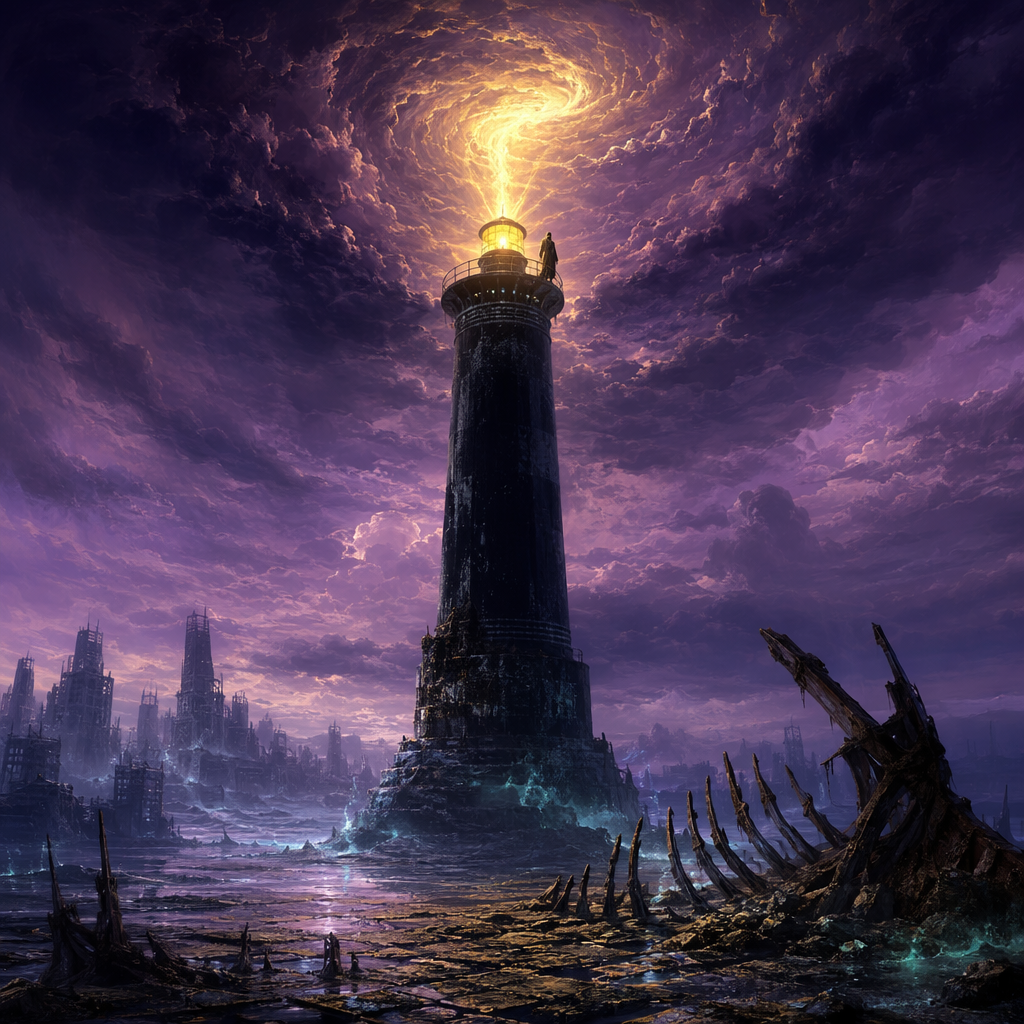
The Beacon Beneath the Last Sea
On a planet shrinking into ash, a solitary keeper learns his lighthouse summons no vessels, but an ancient exile wandering the dark between stars, desperate to return through him.
The Sea That Forgot Its Name
By the time dawn reached the western trench, it had forgotten how to be light.
It came instead as a whitening of the ash, a slow unsealing of the horizon where the last sea lay sunk in its wound. Once, Irian had been told, water possessed distances. It lifted and moved and took ships upon its back like a patient god. Now it gathered far below the cliffs in a seam of dark brine, narrow as a blade-cut, breathing salt into the air with the tired regularity of something that survived only out of habit. The gulls were gone. The piers had long ago become a forest of blackened teeth. Nothing traveled that water except wind, and even the wind seemed to regret it.
Still, the lighthouse stood.
It rose from the headland in pale courses of stone furred with mineral bloom, its skin scabbed by centuries of salt and grit. At its crown the lantern room held the morning like a blind eye. Irian climbed to it before the day had fully formed, carrying his oil can, his polishing cloths, his ledger of weather no one would read. The spiral stair knew his step. So did the iron rail, cold and slightly tacky beneath his palm, forever sweating rust. Ritual had worn grooves deeper than purpose. That was the nature of the end of things, he thought: the body continued where meaning had already gone.
In the lantern room he unshuttered the glass. The panes looked east over orchards turned overnight to a brittle glitter. Where pear trees had stood on the inland slope there was now a grove of crystal anatomy, each branch rendered in translucent white, leaves frozen in the act of curling. Yesterday’s wind had set them chiming. Today they were still. He did not look too long. It was bad luck to watch a familiar thing become unrecognizable.
He went to the lens.
Great nested rings of clouded Fresnel glass crouched around the lamp like slices of some fossilized sun. His father had taught him to clean them with vinegar and lintless cloth, with patience, never with haste. Smears became halos; halos became lies. Irian worked in silence, circling the mechanism, wiping salt from the prisms until his bent reflection multiplied and broke apart in every face of the glass. A man in pieces, made briefly radiant, then lost again.
Below, from the village abandoned thirteen years ago, the bell in the chapel tower gave a single note. Not from any hand. Metal did strange things now in the cold before morning; it contracted, remembered shape, and sang. Birds used to answer. Birds used to embroider the air at first light in such numbers that the sky seemed written over. These days they fell instead. One yesterday in the cabbage patch, one on the path last week, one striking the lantern glass in the night with a sound no heavier than a glove dropped to the floor. Their bones were almost weightless when he gathered them.
He trimmed the wick, checked the valves, and fed the lamp. Fuel sloshed through copper veins into the burner with a medicinal smell. The mechanism beneath the lens shivered, accepted its task. Cogs engaged. A measured ticking entered the room, austere and companionable. This, too, was obsolete. No vessel had answered the light in thirty-two years. No fisherman climbed the switchback path cursing weather and blessing the beam. No signal flashed from the trench. Yet each evening he turned the beacon, and each dawn he extinguished it, because to cease was a kind of murder, and he had not yet decided what in this place he was willing to kill.
He set his ear, as he often did, to the brass housing around the clockwork.
Tick.
Tick.
Tick.
Then—
A pause, so slight it might have belonged to his blood.
Under the tidy mechanical pulse, another rhythm moved. Not a knock. Not the catch-and-release of a damaged gear. Something slower and deeper, with an interval too patient for any machine made by hands. It seemed to come not from within the mechanism but through it, as if the tower were merely the bone casing of a larger thing hidden in the cliff.
Irian straightened. The room had altered without changing. The panes were the same dim panes, the lens the same bright carcass of glass, the sea trench still breathing below. Yet the hairs lifted along his wrists. He waited.
Tick.
Tick.
Then the other beat again, low as a fist against a distant door.
He knelt and opened the service hatch in the pedestal. Gears turned in oiled precision, teeth meshing cleanly, pendulum swinging true. He touched each housing, each spindle. Nothing misaligned. No fracture. No drag. And still, through the metal, through the stone under his knees, that buried pulse resumed—older than the lighthouse, older perhaps than the cliff into which its foundation had been sunk.
Outside, something cracked.
He looked up sharply. Across the ashen noon of the sky, the moon hung over the trench, enormous and thin, its white face traversed by a black seam from pole to pole, like an eggshell mended with night. As he watched, a splinter of brilliance sheared from its lower rim and vanished beyond the horizon without sound.
The second pulse struck once more, harder this time.
Not in the lamp.
Below it.
Below him.
From the deep rock under the tower, where no sea chart had ever named what waited there.
Irian closed the hatch with trembling hands, already turning toward the stairs.
Instructions in Salt and Fire
He went down with one hand on the wall and the other on the iron rail, descending through the lighthouse’s throat as if entering the body of some patient beast he had fed all his life without ever asking what hunger lived in it. The stones sweated cold. Dust furred the steps. Beneath his boots, beneath the old obedient groan of weight and rust, the second pulse continued—slow, immense, and intimate, as if a heart had been mortared into the foundation before the first brick was laid.
The lower vault had always been a place for spare things and relinquished things: coils of salt-stiff rope, emptied oil casks, a speaking tube stopped with wax, brass fittings gone green with long neglect, crates whose labels had faded into anonymous weather. Irian brought a hand lamp from its hook and moved among them while above him the beacon turned and turned, laying its measured radiance across the dark. Each pulse from below went through the soles of his feet, up his shins, into his teeth.
At the back wall stood a sea chest he did not remember seeing, though perhaps he had forgotten it by force of years. The wood was blackened as if it had once been dragged from a fire; the hinges were filmed in white salt. No lock remained. He lifted the lid, and a smell rose from it unlike the room’s dry mineral age: brine, lamp smoke, old paper, a faint sweetness like kelp rotting under summer suns no longer possible on this world.
Inside lay journals wrapped in oilcloth. The first cover cracked in his hands. The pages were crowded with writing so familiar that for a moment he believed he had done it himself while sleepwalking through another life. The script leaned slightly forward, elegant but urgent, every letter formed with the same decisive pressure. Only the date undid him.
Three hundred and twelve years before his birth.
He opened another. Two centuries after that. Another still, older than both. Different paper, different inks burned brown or gone blue with age, but the same hand running through all of them, the same narrow loops in the g, the same slash of the t, the same habit of beginning each entry as though continuing a sentence interrupted not by days but by generations.
I dreamed the door again.
So began one.
The threshold lies below the well of the lamp, under the root-stone, under the sea that is no longer sea. It appears only in drowning sleep.
Another: The water in the dream stands upright like glass and has stars in it. Behind it a shape waits with the patience of continents.
Another: We are not keepers of warning but of return. The instructions are in salt and fire. Turn the lens until the lost coast answers.
He read with the hand lamp trembling against his knee. Fragments recurred like litany. A doorway submerged beneath the beacon. A harbor erased from every chart. The need to maintain the lamp though no ships came. The insistence—written in centuries apart and always in that impossible hand—that the light must never fail at the ending of the world, because endings were when channels opened, when the dead sea remembered its depth, when time thinned enough for the exile to see the way home.
Above him, something changed.
The turning beam thickened. It did not merely pass across the windows; it entered the stone. White fire spilled down the stairwell in bars and sheets. Irian snatched up the journals and ran upward, the pages flapping against his wrist like trapped birds. By the time he reached the lantern room, the night outside had been unmade.
The beam no longer crossed the wasted coast he knew. It cast out impossible geographies that hung in the air beyond the glass, lucid as memory and as unstable. Shores appeared where the ash plain should have been: black beaches veined with luminous shells, cliffs banded in colors no rock on this planet had ever held, forests of towering fronds moving beneath tides not of wind but of water suspended in the sky. Whole continents wheeled soundlessly in the dark, not solid exactly but insistently real, as if the light were finding them rather than inventing them. Above those phantom lands, the heavens had become oceanic. Swells rolled among the stars. Silver currents bent around the cracked moon. And in those currents, at the edge of sight, enormous shadows turned.
Not one. Several. Or one so vast its body occupied many distances at once.
Each time the lens revolved, the coastlines sharpened. The beam struck the air and the air answered. Irian saw then what the old entries had tried to say in the cramped ferocity of their script: the light did not reach outward into space like a plea to passing ships. It bored backward—through the strata of years, through vanished waters, through all the extinctions the planet had suffered and would yet suffer—calling along an older route than history, marking the drowned approach to a harbor the world had buried under its own forgetting.
The pulse from below hit hard enough to ring the glass.
The shadows in the sky-ocean altered course.
One of the journals had fallen open in his hand. At the bottom of a page, in that same unaging script, one line had been written so deeply the nib had nearly torn through:
When it arrives, open the door before it remembers how to enter without asking.
The next blow from beneath the tower threw him against the lens. Somewhere far below, stone split with the unmistakable report of a seal giving way. Irian caught the railing, clutched the journal to his chest, and ran for the stairs as the beam behind him swung its terrible welcome across the dark.
The Guest in the Lens
The stairs shook under him as if the tower had grown a spine and was trying, at last, to rise. Stone grated on stone in the dark below, a deep mineral complaint that seemed to come not only from the lighthouse foundation but from the whole ruined planet, its old crust tightening over a cooling wound. Irian had one hand on the wall, one on the iron rail slick with salt, and every few steps the beam turning above him sent a pale revolving blade through the stairwell slit, laying impossible shorelines across the steps: black beaches under green auroras, drowned cities hung with anemones, a horizon bending inward like the inside of an eye.
Outside, from beyond the thick walls, came the distant clamor of departure. Bells from the lower settlement. Cart wheels. The thin, animal crying of people loading what little could be carried and abandoning what could not. Inland, always inland now, toward the ash plateaus and the collapsing rivers. He imagined them looking back once at the lighthouse and seeing its lantern burning stranger than any stormlight, and hurrying faster, as villagers once fled a shrine after hearing a god clear its throat.
He had reached the landing below the lantern room when the song began.
It came through the glass first as a tremor, so low he felt it in his teeth before he heard it, a sonorous moan vast enough to seem made by weather rather than throat. Then another, and another, rising and descending in intervals older than grief. Whale-song, he thought wildly, though there had been no whales in the Last Sea for generations, only boneless silver things and the floating mats of blind kelp. The notes moved through the lens and all its prisms, and the entire tower answered. Every pane sang. Every bolt in the iron frame took up the resonance. The stair under his feet became a ribcage.
He turned back upward without knowing he had chosen to. The lantern room was full of revolving blue. The great lens, tier on tier of cut glass, held the beam the way a cathedral holds winter, and within it something was assembling out of refraction and distance, a largeness learning how to occupy the shape of light.
The song stopped.
“Irian,” said his mother’s voice.
He went cold so suddenly it hurt. The room sharpened around him with unbearable clarity: salt fur on the window latches, the faint soot trapped in the brass seams, the cracked skin over his knuckles.
“Irian,” said his brother, dead at twelve beneath a harbor wall. “Don’t be afraid.”
Then his father, who had drowned in two fathoms of ordinary water before the sea began to fail. Then Mara, whose face he had not let himself fully remember in years, because memory had become too expensive and solitude too long. The voices came not one after another but through one another, as surf moves through shingle, each distinct and each altered by the same tide speaking underneath.
He backed against the chart table. “You are not them.”
“No,” it said, and now the answer came in no human voice at all but in a pressure of meaning that laid itself gently through his mind. “But I crossed them on the way to you.”
The light thickened. It did not brighten; it deepened, becoming oceanic, a medium rather than an illumination. In it he saw a contour immense enough to humble language: not a face, not a body, but the suggestion of both at scales for which mountains might have served as features. A pupil opening like an eclipse. A flank ribbed with trenches. The slow unfurling intelligence of something that had once moved by continent and by moon-pull.
“Who are you?” he whispered.
The lens sang around the answer.
First tide. First shore-break. The weight that taught basins how to yearn downward. That which was loved before it was named and named before there were mouths.
He understood and did not understand. Some ancestral chamber in him, older than reason, dropped to its knees. He saw fishermen thousands of years dead pouring milk into waves. Stone circles flooded on purpose. Children lowered to touch water and lifted dripping as an offering returned. Worship not invented but remembered.
“You were exiled,” he said, the word from the journals tasting small.
A sorrow moved through the room so vast he thought the panes might frost with it.
“I was divided,” it said. “Cast outward. Bound to distance. What remained of me was pinned here to make a world.”
The beam passed over him, and with it came vision.
He saw the planet before history: not blue with seas but dark and cindered, ringed by engines or mountains or laws he could not comprehend. Something had been dragged from between stars and broken across the globe. What had not escaped into the long black became ocean. Not metaphor. Not myth. Body. The Last Sea was not upon the planet. It was the planet’s captive guest, spread thin over stone, thinking in tides, dreaming in weather, evaporating by degrees under a pitiless sun. Every salt pan inland was a scar. Every vanished bay, an amputation. Every century, less of it left to remember itself.
The being reached toward him without moving.
“To return,” it said, with a tenderness that made terror intimate, “I must pass through a living threshold. The door below opens only in flesh that consents.”
Irian shook his head at once, violently, as if refusal could dislodge the vision. “No.”
He saw then what no opening would mean: the seal failing anyway, not as welcome but as breach. The thing beneath the tower remembering force. The remaining seas rising not in storm but in recollection, every coast taken back in a single act of self-recognition. Settlements gone. Inland plains drowned. The planet cracking around a homecoming turned feral.
Mara’s voice came again, though he knew now whose mercy wore it. “Better a door than a wound.”
The tower gave a sudden lurch. Somewhere below, iron snapped. From the vault rose a wet, thunderous knocking, patient no longer.
Irian stepped toward the lens. The light met him like cold skin.
“What will be left of me?” he asked.
The answer entered him with the softness of deep water closing over a diver.
“Enough to open.”
Below, the door began to breathe.
When the Beacon Opens
Night gathered without darkening. The world had burned too long for that. Ash held the horizon in a bruised pall, and below the cliffs the last sea did not so much break as convulse, heaving up steam in vast white throats that swallowed the stars one by one. The settlement fires were a scattered thread inland now, already half-dream, already belonging to survivors who had chosen distance over understanding. Behind them, the lighthouse stood on its basalt spine above the boiling coast, all its stones trembling as if some great animal beneath the earth had begun at last to remember its own name.
Irian climbed instead of fled.
The lantern chamber received him with a heat beyond weather. The lens turned slowly in its cage, each pane washing him in wan colors that seemed dredged from places the eye had no right to know. The song had deepened since dusk. It no longer resembled whales, though whale was the nearest grief the living world had kept for it. It was older than sorrow and larger than prayer: a calling note stretched across gulfs where suns had died listening.
He laid both hands on the brass levers blackened by generations of keepers who had mistaken maintenance for duty and duty for explanation. For one small moment he thought of his mother trimming wick smoke with the seriousness of a surgeon, of his father saying, in the old practical way, that every light is for someone, even if you never see them arrive. Then the tower lurched, and the sea below answered with a sound like a gate drawing breath.
“Enough,” said the presence, not in command now, but in ache.
Irian opened the flow.
Oil, current, whatever hidden artery had fed the lamp since before maps—he gave it all. The lantern leapt. Brilliance struck the glass and did not stop there. It threaded the lens, multiplied, found geometries sleeping inside the tower’s bones. The whole lighthouse unfolded around him with a series of resonant, impossible clicks, as if architecture were only a folded instrument waiting for the correct note. Floors below rotated. Iron ribs withdrew from stone. Deep in the foundation, something answered. The beam that swept the dead sea ceased to sweep at all and fixed upon one place beyond the cliffs, a white column so pure it seemed to erase distance itself.
Not a light, then. A key in the shape of one.
He descended while it opened.
The stairwell no longer ended where it should. The lower door, always swollen with salt, stood wide upon blackness. From beneath rose a glow like moonlight drowned and taught to think. He went down into the chamber under the tower, and there the world’s first astonishment waited: water, lucid as blown glass, filling the room to his knees, then waist, but warm as blood and clear all the way to the carved floor beneath. In it moved not fish but memories.
His childhood hand skimming tide pools. His wife’s shoulder lit gold at dawn before fever took her. The settlement in years when laughter existed casually, like weather. He saw each image swim through the water and through him, untethered from sequence, tender and exact. The chamber walls were not walls but shells of some unguessable engine, scored with spirals, star-maps, tide equations, the grammar of recurrence. Every surface hummed. Above, through the shaft of the tower, the beam poured downward now as much as outward, a pillar joining sky, stone, and submerged door in one intolerable line.
The seal beneath the floor pulsed.
It was not a hatch, not truly, but a seam in reality the color of old pearl. It inhaled. It exhaled. With each breath the boiling sea outside rose screaming against the cliffs, and with each breath the room filled with the smell of storms that had never crossed this planet. Irian understood then what consent meant. Not permission abstractly given, but the making of a shape within the self: an opening no force could counterfeit.
He was afraid to survive. More afraid not to.
The voice came around him with no single mouth. “If I return unwelcomed, I arrive as hunger. If I return through witness, I arrive remembering proportion.”
“Then remember it,” he said, and stepped forward.
The water lifted to meet him. Light entered his skin like cold fire. The seam opened not outward but through him, and the pain of it was so exact it became almost knowledge. He felt his body translated into threshold—heart taking on the rhythm of tides larger than continents, bones rung like tuned metal, every grief in him turned from wound to aperture. The beam widened. The chamber vanished in radiance.
Outside, the coastlines rose.
For one breathless, impossible interval the dead world wore again its first abundance. Reefs unfurled in the air above the cliffs, branching coral of crimson and milk-white gold, blooming as if water were only a habit life could briefly discard. Dry bays filled with spectral surf. Rivers flashed in their ancient beds. Far inland, dunes darkened to remembered marsh. The planet shuddered between extinction and absolution, unable to decide whether it was being ended or forgiven.
Through Irian, something immeasurable came home.
It did not descend like an invader. It assembled like music heard correctly at last: vast intelligences of current, pressure, moon-drawn longing, a body once broken into oceans and imprisoned in gravity, now gathering its lost immensities through the narrow mercy of a human will. He saw, or was shown, the exile between stars—ages of cold without shoreline, of circling ruined suns with all its names stripped away. He felt the terrible gentleness with which it had waited at the edge of this dying world, asking entry of the smallest creature capable of answering.
Mercy, he understood in the blaze, was not the refusal of suffering. It was the act by which suffering was made to bear arrival.
The tower screamed. Stone split. The resurrected sea reared luminous below the cliffs, and from within its rising body an eye older than planets opened on him in love and storm.
Then something else moved in the light behind it, swift and dark, as if the door had been seen from farther out—and Irian, burning at the center of the beacon, turned toward the second coming shape.